How does semi-supine help musicians?
(Or: why are we always lying down?)
5/17/20266 min read
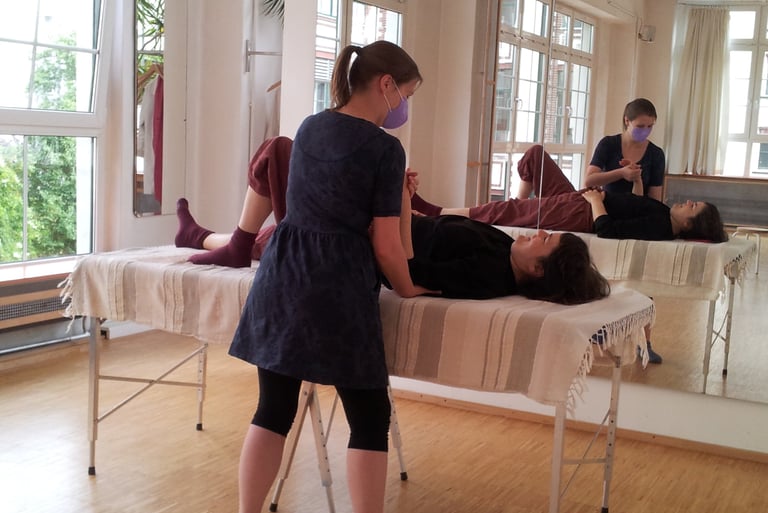
If you have taken an Alexander Technique lesson before, there’s a good chance your teacher may have asked you to lie down on the table or floor, with your knees bent, feet flat, and a paperback book supporting your head. This position is so well associated with the Technique that you’ll find pictures of it on the websites and social media pages of hundreds of A.T. teachers worldwide, in an attempt to demonstrate what our work involves. My first contact with the Technique was as a very stressed, overworked, classical music student, and it was well-known among my fellow students that the elective Alexander Technique course at the conservatory was the one where you could lie down for a while and rest your aching body before heading back into the practice room for another round of scales. Now, there’s nothing wrong with this; lying down in semi-supine for a while will absolutely do us good and is certainly a pleasant experience for most people. Indeed, as an A.T. teacher, of course I want my students to associate the Technique with the sensation of ease and comfort that usually comes with lying down on the table or floor. But why does this practice actually help us as musicians, in the practice room, on stage, and in daily life?
The first, perhaps most tangible reason, has to do with gravity. Gravity pulls us towards the earth, and while we’re generally pretty well-equipped to deal with this force, it can sometimes get the better of us, especially when it comes to our spine. The spine is comprised of twenty-four bony vertebrae, with softer, collagenous discs in-between that act as shock-absorbers. When we spend a long time upright - either standing or sitting - it’s quite common for the spine to become more compressed, the discs losing some of their volume and the vertebrae sitting closer together, which overall causes us to appear slightly shorter. Besides the appearance, this compressing has a whole host of knock-on effects: the ribs (being attached to the spine) can also become compressed, making deep breathing more difficult; the natural curves of the spine might get more pronounced, which can be painful and also affect our balance; when we’re out of balance, muscles which are not intended to support posture end up doing so, which creates more muscular tension overall; and in extreme cases a compressed spine can result in an extremely painful herniated disc. Generally this is something we should try to avoid! So how does lying down help us here? When we lie down horizontally, gravity is no longer acting on the spine in the same way - it’s not compressing one vertebra on top of the next. This means that it suddenly becomes so much easier to allow the spine to expand to its full length and its natural curvature, because we don’t have to struggle against the downward force anymore. It’s like lifting a weight and letting your whole back breathe again. Add to this the fact that the knees being bent (so that you’re in semi-supine, not totally supine) also helps us avoid uncomfortable compression in the lumbar region, lying on the floor or table is a quick way to give a very effective and much-needed rest to your spine, allowing you to go about your day refreshed, expanded and relaxed.
This resting and expanding of the spine is often the first benefit that people notice after lying down in semi-supine for a short time - for a while afterwards, we walk around feeling so much lighter, like walking on clouds - but this is truly just the tip of the iceberg. Besides making us feel comfortable, this lying down position, importantly, makes us feel different - and when we feel different, it’s often easier to pinpoint the things that are bothering us. Here’s an example: recorder players (and most wind instrumentalists) often experience issues with the left shoulder, which has to do with the way we position our hands to play our instrument - the left hand is held above the right hand, which often causes us to raise the left shoulder and/or shorten the right side of the body. Of course, no musician wants to be doing this - it’s not at all intentional - and yet the issue is a common and persistent one. It continues to happen because, in the moment, we don’t realise that we’re doing it (or perhaps other things like, say, the music, understandably take priority at the forefront of our mind). Once the shoulder-raising has become a firm habit, it becomes even more difficult to perceive when it’s happening, and so even more difficult to stop doing it, because it’s simply a part of the background of playing our instrument; it’s ‘normal’. So how can lying down help us bring these subconscious habits back to the front of our mind? By putting the body in a horizontal position, you’re no longer in the situation where that habit has become normal; since you probably don’t usually play your instrument lying down, that shoulder-raising habit doesn’t ‘belong’ in the lying down position and therefore suddenly feels very noticeable. Additionally, the table itself is giving us feedback here. If you play standing up, you probably have contact with the floor and with your instrument, and that’s it - so you have very little physical feedback from your surroundings, or in other words, it’s up to you to notice if one shoulder has crept up higher than the other. If you’re lying down however, you are in contact with the table or floor all along the back of your body: your head, shoulder blades, ribs, pelvis, and feet are all making contact with the surface, giving you so much more feedback as to where there is unevenness or tension in your body. In the absence of an A.T. teacher, the table or floor can often be the one to point out habits that you hadn’t noticed before, because it’s suddenly glaringly obvious that one shoulder is laying on the surface flatter, rounder, higher or lower than the other. The added bonus here is that once you become accustomed to noticing things on the table, you also become more attuned to noticing them off the table too.
Finally, lying down plays a huge role in teaching us how to ‘let go’ or release unnecessary tension. The muscular tension that musicians experience while practicing is often… well, practiced. Since we all know by now that practice doesn’t make perfect, it makes permanent, when we continue to practice in a way that involves a lot of tension, all we are doing is reinforcing and teaching the muscles that they need to create that tension for the task of playing our instrument. Staying with the example of the tight, raised shoulder: when a teacher asks you to let go of that shoulder tension while you’re playing, or even just with your instrument in your hand, it might feel like an impossible task - like the body has no idea how to go about letting go of that tension, because it feels so necessary to the activity of playing. Alternatively, you might manage to lower the shoulder, but do so by pushing it down, or in other words, adding more tension on top of what was already there. Lying down in semi-supine offers an alternative: again by taking you out of your usual standing-up-and-playing situation, and by giving you a wide, solid support with plenty of contact points along the back of your body, with time and patience you can gradually teach your muscles that it’s okay - that it’s safe - to let go of some of that tension. When you are lying down, there’s no subconscious worry about falling, losing balance, dropping the instrument, or playing a wrong note. Instead, there’s the constant feedback from the surface you’re lying on, telling your system that you are supported, that if you release the shoulders a little, nothing bad will happen, and that in fact, releasing those shoulders feels better than holding them fixed in place. You can then take this knowledge, the memory of how it felt not to tense your shoulders, apply it the next time you are standing or sitting to play your instrument, and over time teach your muscles that a freer, lighter way of playing is indeed possible.
Above all, lying in semi-supine is a lesson in doing less. Making the decision to take fifteen minutes of your day to lie on the floor, instead of practicing, scrolling, or doing the dishes, is a powerful thing, which slowly teaches both your mind and body the value of calm, of quiet, of release and of presence. It’s essentially a meditation, of a sort, and I encourage anyone to incorporate it into their day and enjoy the benefits mentioned above, among many, many others.