

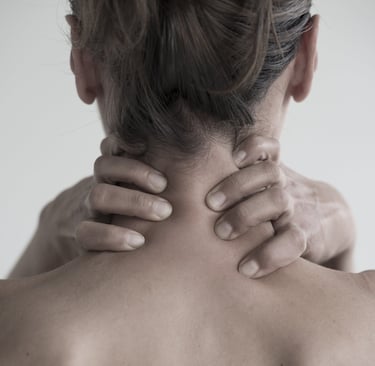
If you have had an Alexander Technique lesson before, you most likely will have encountered this very specific set of directions:
“Allow your neck to be free, so that your head may go forward and up, so that the back may lengthen and widen.”
These words sit at the core of the technique, and their function is to encourage a gentle but noticeable relaxation and expansion of several key postural muscles. Essentially, their job is to bring your system to a state of alert (but not tense) readiness, in preparation to carry out, with the least tension necessary, whatever action might follow: sitting down, speaking, picking up an instrument, etc…
Interestingly, in this case the words chosen are perhaps just as important as the actions themselves. The language chosen is noticeably passive: it isn’t “bring your head forward and up” nor is it “stretch your back”, because these actions would involve far too much muscular effort, and ultimately tend to lead to more tension, not less. This leads us back to the question then, how can you “allow” the neck to be free, when “allow” implies not adding anything new to the mix, but taking a (metaphorical) step back and letting the neck return to an elusive state of freedom? It is an act of non-doing that can become increasingly frustrating when we aren’t even sure what a free neck feels like anymore.
The goal of the phrase “allow your neck to be free” is to let go of excessive or unnecessary tension that the neck muscles may be carrying (and in most of us, they certainly are carrying some). At the same time, we should recognise that the neck has several layers of very strong muscles, which most of the time are taking care of not letting the head fall onto the ground - so given that these muscles have a very important job to do, “free” is in this case not the same as “totally relaxed”. Once we accept that “free” means not working overtime, while definitely still doing the essential work, a free neck can seem a lot more achievable.
If you have ever fallen asleep on a bus, you have probably experienced what happens when some of the neck muscles actually “let go”; the head drops forward in free-fall for a fraction of a second, then is usually righted again very swiftly - since dangling down from the top of the neck is no suitable position for the head…
As adults, allowing the neck to be free can be a difficult process, because we are so used to the excessive tension we’ve been carrying around for so long. One way to gently teach the your system what “free” can feel like, is to put your body in a new, low-stakes situation. This is where lying on the floor in semi-supine comes in: while lying down, the neck no longer needs to support the weight of the head (approximately 5-6kg), so it can slowly start following the mental cues to be free - without the subconscious worry that the head may become unbalanced - because the floor or table has taken over the work of supporting the head.
While upright, it becomes a little trickier because your system has to go about figuring out how much tension it can safely let go of - although it will have already started to learn this through the practice of lying down. Sometimes a small mental detour can be what the nervous system needs: if your system doesn’t know how “free” feels yet, try thinking “soft” instead and imagine the entire neck as having the texture of a puffy pillow; alternatively, think of the circumference of the neck expanding; or imagine the muscles at the back of the neck slowly growing longer.
The key thing here is patience; as long as you’re trying hard to free your neck, it won’t work! Instead, I like to treat “allow the neck to be free” like tuning an instrument: when you play a new instrument, you wouldn’t expect to hit each note perfectly in tune every time straight away; rather, it takes experimentation and patience. When it comes to the neck, it can be useful to think of it like this: “can I allow my neck to be 1% freer than it was yesterday?” All the while also listening to the muscles of the neck (and back and shoulders) and how they’re responding to this request. Still feel tension? Then go for another 1% tomorrow. Slowly, surely, the muscles in the neck will learn that it’s safe to let go a little bit more, and a little bit more.